Tampilkan postingan dengan label different. Tampilkan semua postingan

Rabu, 25 Mei 2016

Pros and Cons of Different System Types

,
Commercial Aquaponics


Ive been trying to compare the pros and cons of different types of aquaponic systems recently.  Right now, Im working on constructing a 105 gallon setup at my friends apartment.  Were making a simple flood and drain system, with a 50 gallon grow bed.  Filling that grow bed will require almost 200 Liters of expanded clay or some other media.  All that media is going to double the cost of our system.  We were thinking about alternative methods, such as expanded shale or even something like legos (but we dont have nearly 50 Gallons of legos).  The cost of buying a grow media for a large grow bed is so high, that it really got me thinking about alternative systems.  Heres a list of pros and cons of various aquaponic systems.  If you know anything that I havent listed, please leave a comment and Ill add it to my list and credit you.


Media Bed Systems
Chift Pist, Simple Flood and Drain (Ebb and Flow), Constant Flood (Continuous Flow)
Pros
· Self Cleaning - The grow media filters out the fish waste
· A media bed performs three (3) filtering functions:
    · mechanical (solids removal)
    · mineralization (solids breakdown and return to the water) 
    · bio-filtration
· Media provides better plant support and is more closely related to traditional soil gardening because there is a media to plant into

Cons
· Expensive growing media

A Typical Media Bed


Chift Pist
Pros
· Pump is in sump tank away from fish and wastes
· Water level in fish tank remains constant
· Great if you have a tall fish tank
· Larger water volume because of sump
Cons
· Extra equipment required (sump tank)
· Must have tall fish tank or stand
· Can take up larger footprint

Chift Pist system


Simple Flood and Drain / Ebb and Flow
Pros
· The grow bed can be separated from the fish reservoir
· Simple design - Only two major system components - lower cost
· It is easy to understand and learn
· Great if you have a tall fish tank
Cons
· Requires a timer or bell syphon
· Pump is in fish tank, exposed to fish and waste
· Water level in tank fluctuates a little


Simple Flood and Drain system


Constant Flood / Continuous Flow
Pros
· Same as the Simple Flood and Drain, except when you remove the timer, the system is constantly flooding
Cons
· Pump is in fish tank
· Plant roots can become waterlogged, and areas of the grow bed can become stagnant and anaerobic as the flow of fresh water through the bed moves around any blockages
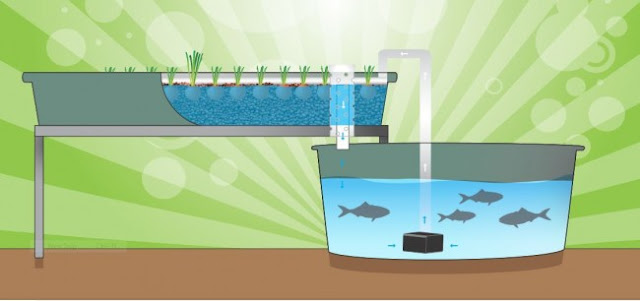

Constant Flood system


Deep Water Culture (DWC)
Pros
· Resistant against water temperature and pH fluctuations
· Excellent root development due to easy access to oxygen
· There is plenty of surface area for the beneficial bacteria to grow
· Very good for lettuces and leafy vegetables – used extensively by commercial farmers
Cons
· Requires additional filtration to remove solids
· Large plants such as tomatoes, cucumbers, etc. can be difficult, if not impossible, to support


Deep Water Culture system


Nutrient Film Technique (NFT)
Pros
· Both components (fish and plants) may be decoupled from each other whenever required and can/do operate independently of each other if required.  I believe this is important in a commercial situation because it allows fish or plant production to continue when and if there are any problems with the other component
Cons
· Water susceptible to temperature fluctuations
· Requires additional filtration to remove solids
· Roots that die and detach from plants can cause blockages in water flow
· NFT is only really suitable for certain types of plants, generally leafy green vegetables, larger plants will have root systems that are too big and invasive, or they become too heavy for the lightweight growing gutters

Nutrient Film Technique system


Sources:
  • http://www.backyardaquaponics.com/guide-to-aquaponics/running-system/
  • http://myownaquaponics.com/home-2/get-started/
  • http://aquaponicgardening.com/wp-content/uploads/2011/08/Aquaponic-Gardening-Rules-of-Thumb.pdf
  • http://affnan-aquaponics.blogspot.com/2010/12/conceptual-3d-rendering-of-aquaponics.html
  • http://www.kijanigrows.com/
  • http://globalaquaponics.wordpress.com/tag/commercial-aquaponics/
  • http://aquaponicsusa.wordpress.com/2011/12/13/watch-our-humble-seed-lettuce-thrive/
  • Comments on reddit that corrected my mistakes:  http://redd.it/1d18i8

Read more

Senin, 23 Mei 2016

Aquaponic Windowfarm Update

,

Our windowfarm is having some ups and downs. The strawberries are growing and starting to turn red.


I planted some garlic and its sprouting.


The rosemary is great.


The parsley is great.


The basil isnt growing. Any suggestions on what I should try to replace it with?


Im going to finally finish the plumbing for Pogos 105 gallon system this week. By next weekend we should have it filled with media and water. Well start fishless cycling, and hopefully be growing soon!
Read more

Sabtu, 16 April 2016

Different Soil Type A Basic Idea On Soil Classification

,

Today I will discuss about the soil and its types. Soil is the main food source for plants. So it is better for a gardener to know more about this important factor of gardening. Many of the plants die in the garden due to the lack of proper soil. Every plant have their own preference for soil. By knowing the types and their properties we can definitely increase the chance of plant survival.

Depending on the presence of 3 different particles(sand, silt and clay), the soil are classified into 4 basic types. They are sandy, silty, clay, Loamy.


Sandy soil:
To start with, sandy soil  has mostly the largest sized particles in them. The particle size is over 1/20 mm in diameter. Upon touching you will feel it as much more dry and gritty with compared to other soil. This type of soil is very light in weight and can warm up very quickly in the spring. Due to its large particle size they do not pack as closely like other type of soil and thus has a very good aeration and good drainage capacity.

The downside of the story is it drains very quickly, the plants get very less time to absorb the nutrients with generally drains off with the water. You can improve the water retention capacity of the sandy soil by adding organic compost , peat moss etc, these will help to retain the nutrient as well as moisture.

Silty soil:
Silty soil has much smaller particles compared to sandy soil. If you touch the soil with your finger it will give you much smoother feeling compared to the sandy soil. It is a intermediate between sandy and clay type of soil. It retains water longer than sandy type. The drainage and aeration is far less than the sandy type. Due to its water retention, this type of soil doesn’t warms up so easily.

Clay soil:
It contains mostly the particle which is sized less than 1/200 mm in diameter. If you touch clay type soil in wet condition you will feel the stickiness in the soil. Here the particles are packed very closely leaving very little space for aeration and drainage. It can hold more water than any other type of soil. As it has a tighter grip on the drainage it can hold on to the nutrients. It is very rich in plant food for growth.
This type of soil warms up very slowly in the springs. It can become very hard once it gets dry. So it can be a problem working with this type of soil specially in the time of summers. If properly managed this soil type can be the best for plant growth.

Loamy Soil:
It is a mixture of sandy, silty and clay type of soil. Generally most of the gardening is done in this type of soil. If put mixed with proper organic matter this type of soil is easy to maintain and required very little add-on.


Having said all that these soil types are not permanent in nature and you can definitely alter the nature of the soil. So don’t be disheartened if your near by soil is not suitable for the type of crop you are thinking about growing. Here is a list of materials which you can add to your soil and change its aeration or water retention capacity.


That’s all for today. Will come with some other interesting topic in the next article. If you are a first time visitor to the site you can check our archive section for more gardening related articles.
Read more

Jumat, 25 Maret 2016

Different soilless media for growing plants

,

For a good growing media it is necessary that the plant gets a healthy balance of water and air.Soil sometimes contains harmful bacteria and fungi, and prone to be infected by pests, weeds and soil-borne diseases. The soil-less media are generally considered cleaner and sterile. These media, as the name suggests, doesn’t include soil; plants are grown in different organic or inorganic materials. Soil-less media are getting more and more popular particularly among container gardeners these days.


Some of the most commonly used alternative media are:
1.       Peat moss: It promotes good aeration and water retention capacity. It is light weight and sterile and ideal for germination of seeds. Usually used with other other media.
2.      Perlite: These are basically expanded volcanic rocks and white in colour. It is very lightweight and holds air. Unlike peat moss it doesn’t hold water so need to be mixed with other media for best use.
3.       Vermiculite: It can be used as a substitute of perlite. Like perlite it also doesn’t hold water. It can retain nutrients and help a mix resist changes in pH(a measure of the alkalinity or acidity of a medium).
4.       Coarse sand: It is another medium used by people. Though it improves drainage and aeration, doesn’t retain water.
5.      Coconut coir:Now a days this medium is getting more and more popular. It is the extracts from the coconut husk. It has the same properties as peat moss but with much less mess.


 Your own mix:
Depending upon your choice of crops you can prepare your own mix. Standard practice is mixing Coconut coir(or peat moss), perlite(or vermiculite), small amount of fertilizer(Soil-less mix doesn’t have much fertility by itself. So you need to provide fertilizer from outside) and ground limestone(so that soil-less mix will contain the nutrients also).  There are several other soil-less mix recipes available online which you can easily find. Also there are several ready mix available for you to buy.

For best results:
  1. Lightly moisten the mix before filling the container.
  2. Don’t pack the mix too tightly when planting.
  3. Water thoroughly after planting.
  4. In absence of fertilizer in the mix, start fertilizing two or three week after plantation.

Read more about soil-less media:
Why you should grow strawberries in Coir?
A Miracle grow called Organic Potting Soil: The best soilless potting Mix
Coconut Coir and its use as a Soil-less Growth Media 

I would be very happy if this blog helped you in any form. Please post anything you want to share.
Read more
 

Aquaponics Build Copyright © 2016 -- Powered by Blogger